
The Union Finance Minister Pranab Mukherjee on Thursday hoped that the steps taken by the government and those by the Reserve Bank of India would bring the inflation down to six percent by the end of this financial year.

The economic slowdown and the accompanying moderation in the pace of revenue growth has adversely hit the financial health of governments, both Union as well as states, in the financial year 2008-09, according to the Reserve Bank of India's quarterly review of the economy.
The department of economic affairs in the Union finance ministry has suggested aggressive sterilisation of foreign capital inflows, tightening of government expenditure and intervention in key farm produce markets like wheat.

In the broader market, BSE midcap and BSE smallcap indices underperformed the larger counterparts and ended flat with a negative bias.

'Investors hate uncertainty and the demonetisation move certainly creates that.'
Reserve Bank of India is to introduce a voluntary early retirement scheme for its employees.
Reserve Bank of India on Thursday said the bank would use all its instruments to manage liquidity in the system following increased FII inflow.

The Centre has advised banks to make a 20 per cent reduction in expenditure related to non-core business activities, along with deferring "avoidable expenditure" on "purchase of staff cars", "refurbishment of guest houses" and on the interior decoration of administrative and back offices.
Amid ballooning fiscal deficit, the government on Tuesday categorically said that it has 'no intention' to monetise its debt, which implies that it will not directly borrow from the Reserve Bank of India. As fiscal deficit is projected to be at 6.8 per cent of gross domestic product this fiscal and the government has pegged its market borrowings at around Rs 4 lakh crore (Rs 4 trillion) for 2009-10.

India's services sector activity moderated further in January as new business rose at a noticeably slower rate amid the escalation of the pandemic, reintroduction of restrictions and inflationary pressures, a monthly survey said on Thursday. The seasonally adjusted India Services Business Activity Index fell to 51.5 in January, down from 55.5 in December, pointing to the slowest rate of expansion in the current six-month sequence of growth. For the sixth straight month, the services sector witnessed an expansion in output.

DLF, Indiabulls Real Estate, HDIL, YES Bank, Union Bank of India and Maruti Suzuki are down 4-12% on NSE.

Banks shall not charge fees for transactions settled on IMPS and UPI in excess of rates charged for NEFT for transactions above Rs 1,000, the order said.

Accordingly, West Bengal can borrow Rs 20,362 crore, Maharashtra (Rs 46,182 crore), Uttar Pradesh (Rs 29,108 crore), Karnataka (Rs 27,054 crore), Gujarat (Rs 26,112 crore) and Rajasthan (Rs 16,387 crore).

He added that the risks can increase if the Chinese slowdown gathers more speed.

To manage anxious crowds, as many as 3,400 personnel of paramilitary and Delhi Police along with 200 quick reaction teams have been deployed at ATMs and banks.
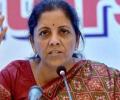
The finance minister's meeting with chief executives and managing directors of banks ahead of the Union Budget assumes significance in view of the critical role the banking sector plays in boosting consumer demand across sectors.

Overall, the record of the second term reveals a contradiction between the image and the reality. The image, especially on media and social media, is one of the man at the height of his power, and unstoppable. The reality on governance is someone who has found it difficult to get things implemented and unsure of what to do next, points out Aakar Patel.

IMF's Chief Economist Gita Gopinath on Thursday said it would be damaging for India to start tightening policy support in the midst of the COVID-19 pandemic and also stressed on reducing wasteful expenditures in the upcoming Budget. Delivering NCAER's '9th C D Deshmukh Lecture' virtually, Gopinath said there is scope for the Indian government to provide more direct support to people.

The home ministry has deputed three top officials to be in touch with state governments to ensure security of banks, ATMs and cash transporting vehicles.
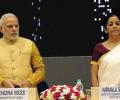
Modi, after delivering his sixth straight address to the nation on Independence Day from the ramparts of the Red Fort in New Delhi, went into a brainstorming session with Sitharaman and all top officials in her ministry, sources privy to the development said. T
Indian firms can invest in listed cos abroad: RBI
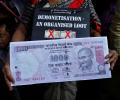
In a big win for the Narendra Modi government, the Supreme Court in a 4:1 majority verdict on Monday gave its stamp of approval to the Centre's 2016 decision to demonetise the Rs 1,000 and Rs 500 denomination currency notes, saying the decision-making process was neither flawed nor hasty.

Soon after RBI announcing a much- awaited rate cut, Chief Economic Advisor Arvind Subramanian on Wednesday said that the global rating agencies should look at upgrading their stance on India's credit outlook. "Now we have a 50 basis points rate cut (in two tranches within two months) and I think that is good for the economy and all rate cuts benefits... If the outlook is looking good, the rating agencies should draw their lessons from that om improving the outlook," Subramanian told reporters. After presentation of Union Budget 2015-16 last week, global and domestic agencies had ruled out any immediate upgrade in India's sovereign ratings and had red-flagged the country's delayed fiscal consolidation roadmap and had also warned against any slippages from the "ambitious" disinvestment plan proposed in Budget. Subramanian said that the rate cut is consistent with the government's views in the last week's Economic Survey and thereafter in the Union Budget for the outlook on inflation and for the outlook on overall economy. "It (rate cut) shows that RBI and government are on the same page in terms of how we view the economy. It also means that Budget can be seen as conducive to non-inflationary growth," he added. On monetary policy framework agreement, Subramanian said that both Finance Ministry and RBI have shared concern about inflation. Recently, the Finance Ministry and the Reserve Bank agreed to 'inflation rate targeting' under which the apex bank will aim to lower retail inflation to below 6 per cent by January 2016.

In the midst of third wave of COVID-19, Finance Minister Nirmala Sitharaman has come up with an impactful Budget which is balanced, fiscally prudent and growth-oriented, the USA India Chamber of Commerce has said. President of the Boston-based USA India Chamber of Commerce (USAIC) Karun Rishi, however, said it is a matter of concern that the budget lacks tangible measures to increase revenue generation. "Opting to keep the fiscal deficit at 6.9 per cent and increase capital expenditure by 35 per cent is a masterstroke. "The annual budget estimates the effective capital expenditure of Rs 10.68 lakh crore in 2022-23, making up about 4.1 per cent of the GDP," he said. "A phenomenal increase in the government's capital expenditure is likely to facilitate the expenditures on infrastructure and create jobs.
The central bank deputy chief said on Monday that the monetary authorities were unlikely to lower the repo rate from the current five per cent for quite some time.\n\n\n\n
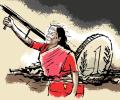
Finance Minister Nirmala Sitharaman will present the much-awaited 2022-23 Union Budget on February 1. While there has been strong recovery in some sectors, touch services like hospitality, tourism and leisure continue to suffer after two Covid-19 waves. Household savings have been hit due to increased spending on health care. Consumption has still not reached pre-pandemic levels.
India's services sector activities contracted further in June as the intensification of the COVID-19 crisis and reintroduction of containment measures restricted demand, a monthly survey said on Monday. The seasonally adjusted India Services Business Activity Index fell from 46.4 in May to 41.2 in June, as new work intakes and output contracted at the fastest rates since July 2020, which prompted companies to reduce employment again. Subdued demand conditions resulted in a second successive monthly drop in new business received by services firms.
Close on the heels of one per cent cut in interest rate on small savings scheme and PPF in the Union Budget, the Reserve Bank of India announced on Friday a 0.5 per cent reduction in interest rate on savings account to 3.5 per cent effective Saturday

RBI wants periodic revision of the pensions for its retired employees.

Union Home Minister Rajnath Singh on Thursday said B R Ambedkar had never thought of leaving the country despite being subjected to insult and discrimination.

Prasad also said India will be a $1 trillion opportunity for digital companies in five years

The Reserve Bank of India, for the second straight time, on Thursday kept its key policy rate unchanged at 5.15 per cent, maintaining its accommodative policy stance as long as it was necessary to revive growth. The central bank retained GDP growth at 5 per cent for 2019-20 and pegged it at 6 per cent for the next fiscal.

Policymakers should aspire to restore the pre-Independence environment where the rupee was trusted and used all over South Asia, in Southeast Asia, in West Asia, and in East Africa, suggests Ajay Shah.
The Parliamentary Standing Committee on Finance's meeting comes against the backdrop of CBI probing the Saradha scam in which thousands of crores or rupees of gullible investors were allegedly swindled.
ULFA has asked an RBI official to pay up.
The 'Rating Level 4' means that the financial market regulators have all regulatory measures "fully in force"
The RBI rejection is a second blow to BoB - the lead bank of both companies -- after a Delhi high court order on August 18 stayed a move by BoB and the entire consortium of lenders to classify these accounts as fraud, restraining them from taking any other coercive action till the next hearing.

Banerjee supported 'Nyay' (poverty alleviation scheme of Congress) and people of India rejected his ideology, the BJP leader said.

Borrowing from BRICS bank will help India avoid other kinds of politics emanating from the West. Overall, the BRICS institutions will necessarily adopt alternative ways of doing things based on their own cultural and socio economic needs, says M K Venu.
 © 2026 Rediff.com - Advertise with us - Disclaimer - Privacy Policy - Sitemap - Feedback - About us - Terms of use - Grievances